

Senegal on the front lines of a climate crisis
As the tangible impacts of climate change become more pronounced in Senegal, it is no surprise that it is increasingly a priority for the country's policy makers. Rising temperatures, decreasing rainfall and increased risk of droughts are a few of the major challenges that are affecting people's lives, livelihood, health and the natural environment in the country.
Senegal's national statistical office (ANSD) and the Ministry of Environment need to adapt to ensure that they can provide information to the wide community of data users who need to understand more about climate change and how to mitigate its impacts.
When ANSD began to develop their fourth national strategy for statistical development in 2023, they realised that they would need to rethink the way in which data and statistics for climate change are integrated in statistical activities. Unlike other areas of statistics, climate change data are diverse and produced by a range of sectors and organisations both in the public and private sector. They require greater data sharing and the ability of integrating economic, environment and demographic data.
Senegal and PARIS21 partnering to pilot a new approach
Senegal turned to PARIS21 for help in using a new approach to tackle the problem of climate change data. PARIS21 had already began to broach the issue of how to improve the collection of climate change data from across a broad spectrum of data producers, and make it available to a wider user community.
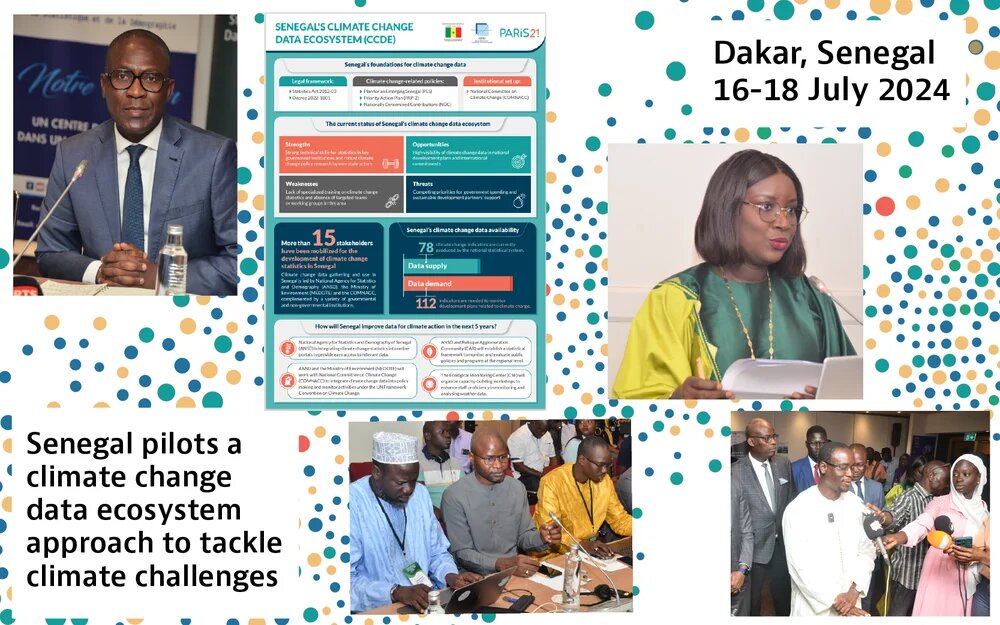
With financial support from the Hewlett Foundation, PARIS21 and Senegal worked together to pilot the Climate Change Data Ecosystem's (CCDE) Framework. Using this methodology and tools, ANSD and PARIS21 were able to integrate, for the first time, a dedicated plan for climate change statistics in Senegal's national planning.
Working together, PARIS21 and ANSD were able to identify where Senegal lacked data, as well as what institutional frameworks were in place that would be conducive to good climate change information - for example the expertise of specialist statisticians working on environmental statistics in ANSD and the Ministry of Environment, as well as robust policy analysis and climate change research from some non governmental institutions.
Sharing lessons with other countries
PARIS21, ANSD and the Ministry of Environment and Sustainable Development of Senegal, organised a regional workshop from 16-18 July 2024 that brought together more than 40 participants from Senegal, Benin, Botswana, Kenya, Malawi, and Togo. The workshop was attended by high-level policy makers who shared insights on the need for quality climate change data to support better climate action.
The workshop enabled Senegal to showcase its experience in implementing the CCDE Framework and tools developed by PARIS21 as part of their National Strategy for the Development of Statistics. Participants were able to engage in meaningful discussions strengthening climate change through statistical planning.
This workshop is a good initiative as it allows us to learn from other countries' experiences, for example Senegal's platform on climate data is a fantastic initiative which could be replicated by other countries
Mapping and understanding its own climate change data ecosystem is essential for Senegal to prepare for the future, make policies to protect its citizens and natural environment. Its experience of developing a CCDE will also be valuable for countries in the region facing similar challenges, improving not only the domestic data value chain, but creating a community to tackle this global challenge.
